France's 5 November protests end with competing counts and a social conference
The marches were larger than the 17 October mobilisation, while official and union estimates diverged and the prime minister called unions and employers to talks on 9 November.
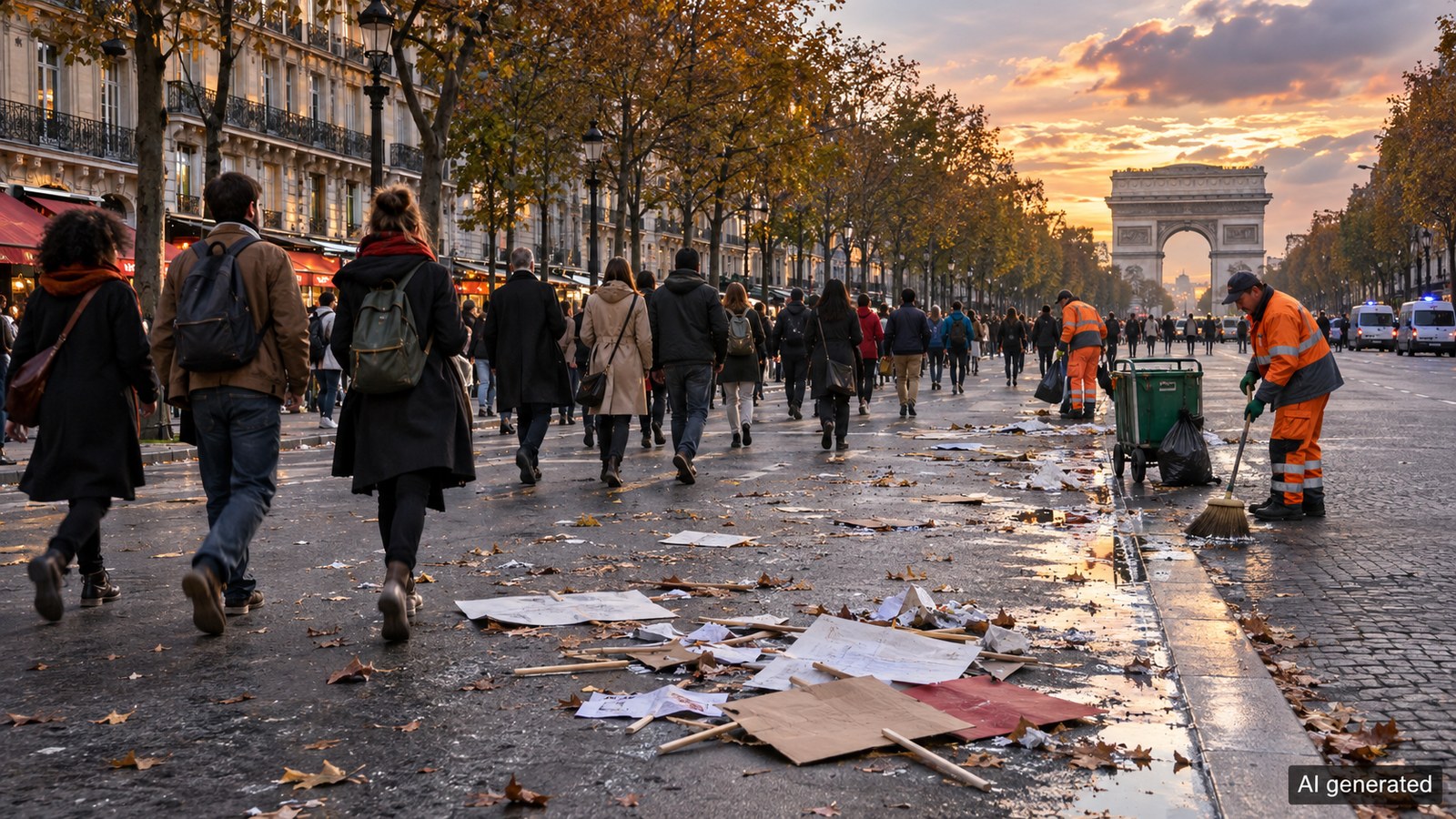
France's 5 November strike and demonstrations ended with a larger verified mobilisation than the unrest on 17 October, but without a single agreed attendance figure. The Interior Ministry counted 575,000 participants nationwide, according to Reuters, while the CGT said 1.6 million. Associated Press reported the official total as more than 600,000. WHIF presents the estimates separately because crowd counts are produced by different methods and are not directly interchangeable.
The marches were largely peaceful, although clashes and vandalism occurred in Paris, Lyon and several other cities. Reuters reported 448 arrests and 53 injured police officers, figures attributed to the Interior Ministry. AP also reported at least 448 arrests. Those national totals do not establish what happened at every march, and isolated violent scenes should not be used to characterise all participants.
Disruption was substantial but uneven
The strike had visible but uneven effects. The Eiffel Tower closed, nuclear output was reduced and some local transport was disrupted. Reuters said there was no major national transport breakdown and that just over 15 percent of teaching staff joined the strike. AP reported that roughly a third of high schools were closed or unable to operate, including schools affected by blockades rather than staff participation alone.
The mobilisation linked wage and cost-of-living demands with concerns about public services and education. Students, workers and pensioners marched together, while unions argued that pay and pensions have not kept pace with essential costs. The figures and slogans show broad participation, but they do not amount to a unified programme or prove that every participant shared the same priorities.
Talks move to 9 November
Prime Minister Sébastien Lecornu has called unions and employers to a social conference on Monday 9 November. Reuters describes the meeting as focused on salaries and the cost of living. AFP reported that the announcement followed what it called a day of social anger. A meeting date is a concrete response, not evidence that the government and unions have reached an agreement.
The outcome also corrects the limits of WHIF's 5 November morning article, which described confirmed closures and security preparations before final turnout and arrest figures existed. That earlier article remains archived as a time-stamped advance report. This update replaces forecasts with the best available post-event counts and identifies the remaining disagreement.
What the mobilisation does not yet settle
The next test is political rather than numerical. Monday's conference will show whether the government offers measures on wages and living costs that unions consider negotiable, and whether organisers maintain pressure after a large turnout. Until then, claims of either a decisive government defeat or a spent movement go beyond the verified evidence.
Sources & context
Reporting and reference material used for this article. Context sources do not independently confirm every news claim.
- Reuters ↗Independent post-event reporting, updated 5 November 2026: competing turnout estimates, arrests, injuries, strike effects and the 9 November meeting.
- Associated Press ↗Independent post-event reporting, published 5 November 2026: official and union counts, school disruption, arrests and the movement's demands.
- AFP via Boursorama ↗Independent wire reporting, published 5 November 2026: the prime minister's social-conference announcement and end-of-day political response.
Written for WHIF from the linked material. This article does not claim on-the-ground reporting. Our editorial standards.