Paris Opera rebuilds the Ring as a 16-hour festival
Two complete cycles mark 150 years since Wagner's tetralogy was first staged, with performances, streaming and a BnF exhibition running in parallel.
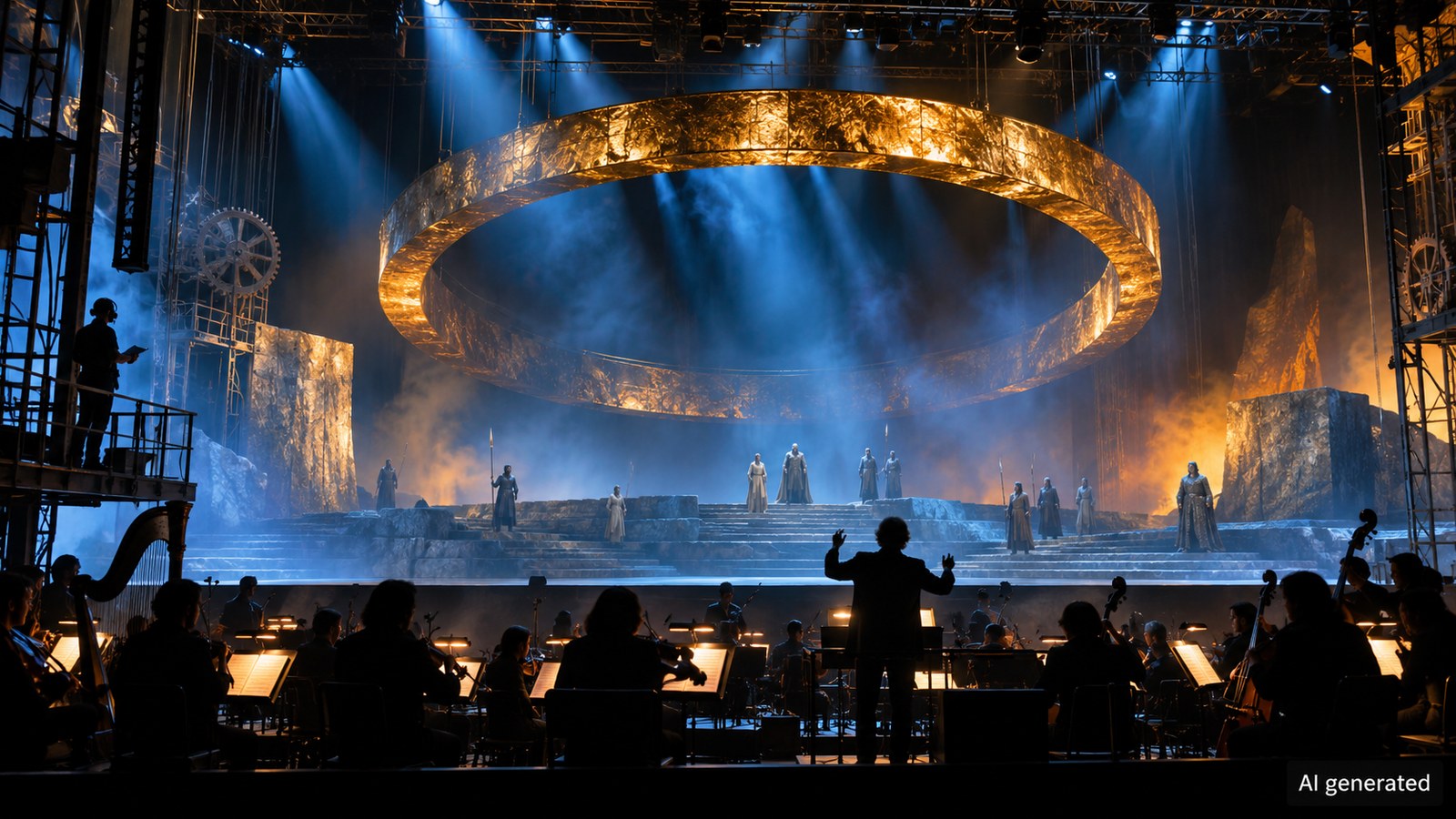
The Paris Opera is presenting two complete cycles of Wagner's four-part Ring as a festival marking 150 years since the tetralogy's first full staging in Bayreuth in 1876. The first cycle runs on 6, 7, 10 and 13 November, with a second on 15, 17, 19 and 22 November. Together the operas require roughly 16 hours of performance.
The project is unusual in Paris because complete cycles demand exceptional coordination across casts, orchestra, chorus, stage crews and audiences. Le Monde reported more than 100 musicians in the pit, a chorus of about 90 and participation by both Paris Opera orchestras. The two cycles were nearly sold out, with international visitors accounting for 39 percent of the audience, compared with a usual share around 20 percent.
Four works, one long dramatic arc
The festival format preserves the sequence from The Rhinegold through The Valkyrie and Siegfried to Twilight of the Gods. Seeing the works across several days makes recurring musical ideas and the consequences of each character's choices easier to follow. It also turns attendance into a substantial commitment rather than a conventional single evening at the opera.
The production is not documentary history. It is a new staging of a work that has accumulated competing interpretations over a century and a half. The Paris Opera's programme places performances alongside talks, podcasts and related events, while Le Monde situates the continuing fascination in the work's musical scale, mythology and political afterlives.
A legacy that requires context
That history includes Wagner's antisemitism and the later appropriation of his music by German nationalism and Nazism. A responsible anniversary cannot separate the artistic achievement from those facts. The Ring itself predates the Third Reich, but modern institutions must explain how the work and its composer have been received, contested and reinterpreted.
The Bibliothèque nationale de France extends that context with 'Richard Wagner, the Revolutions of the Ring', an exhibition open through 20 February 2027. Manuscripts, books, images and audiovisual material trace the cycle's creation and changing stage history. It offers a different kind of attention from the opera house, where scale and sound necessarily dominate.
The festival extends beyond the auditorium
A complete performance is the centre of the festival, but access is broader than the scarce seats. The Paris Opera lists a stream of the second cycle and accompanying digital material. The anniversary is therefore both a major live event and an invitation to examine why the Ring remains powerful, difficult and politically charged 150 years after its premiere.
Sources & context
Reporting and reference material used for this article. Context sources do not independently confirm every news claim.
- Paris Opera ↗Primary festival information: performance dates, four-opera sequence, streaming and accompanying events.
- Le Monde ↗Independent reporting, published 5 November 2026: production scale, audience demand, historical context and critical interpretation.
- Bibliothèque nationale de France ↗Primary exhibition information: scope, collections and run through 20 February 2027.
Written for WHIF from the linked material. This article does not claim on-the-ground reporting. Our editorial standards.